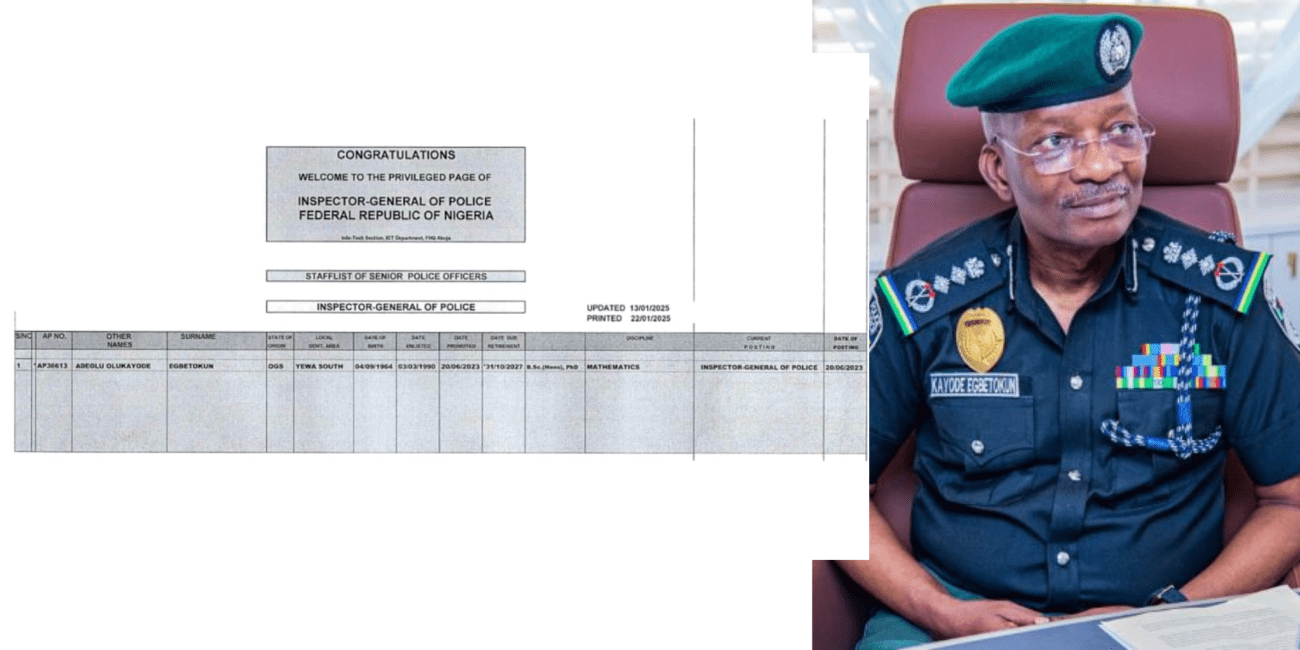
In a development raising serious concerns about governance and transparency within Nigeria’s Police Force, Inspector General of Police (IGP) Kayode Egbetokun has allegedly manipulated his service records to extend his tenure from the mandatory retirement date of September 2024 to October 2027. Documents obtained by SaharaReporters reveal this controversial adjustment, sparking outrage and criticism from various quarters.
Manipulation Allegations:
Egbetokun, whose service number is AP36613, reportedly altered his service profile on January 13, 2024, extending his tenure by three years. Sources within the police hierarchy allege that the extension was achieved through questionable means, including lobbying and financial inducements to secure legislative amendments.
One senior officer remarked, “Egbetokun reached the mandatory retirement age of 60 in September 2023, yet he remains in office. This is a clear violation of civil service rules, which stipulate that officers must retire either at 60 or after 35 years of service, whichever comes first.”
On July 23, 2024, the Nigerian Senate passed the controversial Police Act (Amendment) Bill 2024, which amended the 2020 Act to increase the retirement age of police officers from 60 to 65 years and extended their years of service from 35 to 40. Insiders revealed that Egbetokun was the driving force behind the bill, allegedly channeling significant funds to lobby for its passage.
Critics argue that this move serves Egbetokun’s personal interests rather than the nation’s. Stakeholders such as the Police Service Commission (PSC), the Ministry of Police Affairs, and the National Salaries and Wages Commission voiced strong opposition during a public hearing, warning of dire consequences for police operations and morale.
“The extension will lead to stagnation, dampen motivation among younger officers, and set a dangerous precedent for other agencies,” stated a representative from the Ministry of Police Affairs.
Civil Society and Media Silence:
Civil society groups and the media’s muted response to the issue have also been criticized. Some speculate that veteran journalists and media outlets may have been compromised, downplaying the implications of Egbetokun’s tenure elongation.
“This silence undermines the accountability needed to address the rot within the police force,” lamented another source.
Reacting to the allegations, Force spokesperson Olumuyiwa Adejobi defended the bill, stating it was first introduced during the 8th National Assembly and aimed at improving service conditions for police officers, not for personal gain. Adejobi emphasized that the President retains the sole authority to appoint or remove an IGP, whose tenure is officially prescribed as four years.
The extension of Egbetokun’s tenure has ignited debates about fairness, accountability, and systemic corruption within Nigeria’s civil service. Analysts warn that such actions undermine public trust in the police force, exacerbate stagnation within its ranks, and could embolden similar moves across other government institutions.
With senior officers and stakeholders expressing dissatisfaction, the controversy surrounding Egbetokun’s extended tenure is far from over. As the nation watches, the spotlight remains on the government’s response to these troubling allegations and the broader implications for Nigeria’s civil service integrity.
The extension of Kayode Egbetokun’s tenure underscores deep-seated challenges in Nigeria’s governance structures, raising urgent questions about transparency, fairness, and the rule of law. For a nation grappling with insecurity and institutional inefficiencies, such developments only serve to erode public confidence and exacerbate systemic failures.
Source: Sahara Reporters
 PIONEER NEWS