The Edo State governorship election held on September 21, 2024, was billed as a showcase of democracy, with claims of peace and transparency. However, emerging evidence suggests the exercise may have been compromised, raising troubling questions about its credibility and the neutrality of the Independent National Electoral Commission (INEC).
Despite assurances from the authorities that the process would be devoid of violence and malpractice, the election was clouded by allegations of rigging. Governor Godwin Obaseki had ominously predicted the turn of events, describing the election as a “do-or-die affair.” His warning proved prophetic as the results drew public scrutiny, exposing potential electoral malfeasance.
The election featured 17 political parties vying for control of Edo State, with over 35,000 security personnel, including police officers, military forces, and agents of the EFCC and NSCDC, deployed to maintain order. Yet, the promises of security and fairness unraveled dramatically, particularly in Etsako West Local Government Area (LGA), a key determinant of the election’s outcome.
INEC declared Monday Okpebholo of the All Progressives Congress (APC) as the winner, securing 291,667 votes. He was followed by the People’s Democratic Party (PDP) candidate Asue Ighodalo, who polled 247,274 votes, and the Labour Party’s Olumide Akpata, who garnered 22,763 votes. The decisive 44,393-vote margin between APC and PDP largely hinged on results from Etsako West, a local government shrouded in controversy.
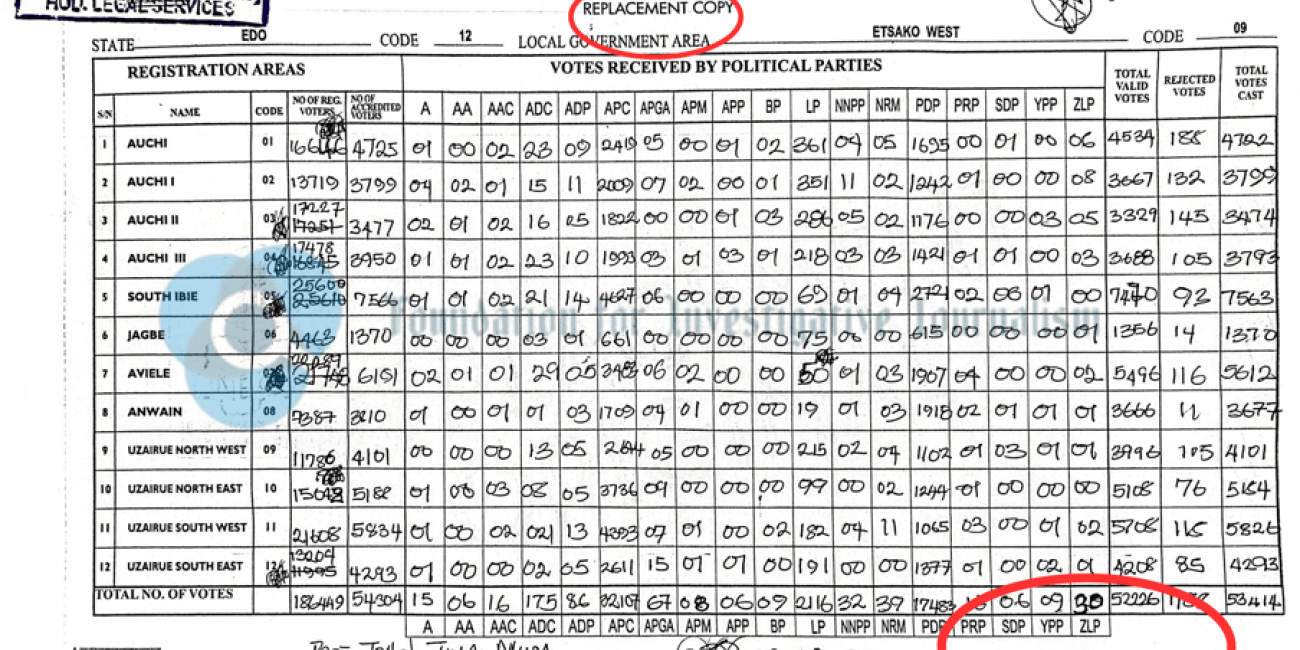
In Etsako West, APC was credited with 32,107 votes, while PDP trailed with 17,483 votes—a difference of 14,624 votes. However, investigations by the Foundation for Investigative Journalism (FIJ) uncovered glaring irregularities.
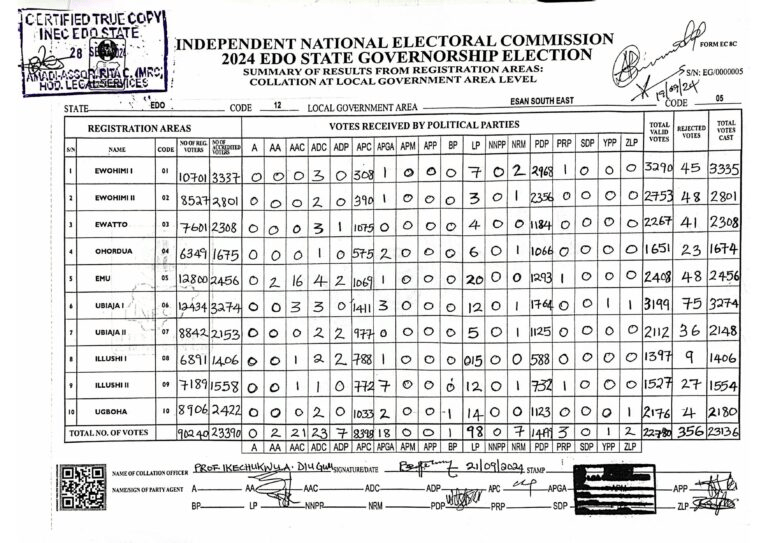
The Certified True Copy (CTC) of Etsako West’s results bore the peculiar inscription “Replacement Copy” and lacked the standard INEC stamp. Unlike other LGAs, no collated results for Etsako West’s 12 wards were provided—a glaring violation of electoral protocol. Yet, INEC included these questionable results in its final tally, fueling accusations of malpractice.
As the election results were being collated at the Auchi Council Hall in the early hours of September 22, gunfire shattered the proceedings. Witnesses reported that unknown assailants launched an attack at around 3 a.m., injuring Benji Ojietu, the deputy chairman of the LGA.
Ojietu, who sustained gunshot wounds, recounted the chaos: “We were still collating results for 10 wards and awaiting two others when the attack occurred. Despite the heavy presence of police, military, and DSS operatives, the attackers gained access and opened fire.”
Eyewitnesses said INEC officials had left the venue before the shooting started, raising questions about whether the attack was orchestrated. No arrests were made, and Ojietu pointed fingers at the police, claiming, “No one else had access to the building.”
Further complicating matters, INEC failed to provide CTCs for 11 of the 12 wards in Etsako West and later announced results without the necessary electoral materials. Similarly, in Oregbeni Ward of Ikpoba Okha LGA, 10,928 votes were mysteriously cancelled without explanation, as INEC failed to supply the mandatory Form EC40G detailing the reasons for cancellation.
The Athena Centre for Policy and Leadership noted that INEC’s inability to account for these discrepancies undermined the integrity of the election. An anonymous source who claimed to have preserved the original results sheets from Etsako West alleged that INEC fabricated results. “How did INEC get those figures when I had the sheets in my possession?” the source questioned.
The alleged irregularities have sparked widespread outrage, with political analysts and civil society groups demanding transparency. Critics argue that the apparent flaws in the collation process and the suspicious incidents surrounding Etsako West and Ikpoba Okha LGAs cast a long shadow over the election’s legitimacy.
As the dust settles, questions remain about the role of security agencies, INEC’s credibility, and the implications of the alleged malpractice on Nigeria’s democratic process. With public confidence in the electoral system at stake, stakeholders are calling for a thorough investigation into the Edo governorship election to restore faith in democracy.
This unfolding saga underscores the urgent need for electoral reforms to prevent a recurrence of such controversies and ensure that the will of the people is genuinely reflected in future elections.

 PIONEER NEWS