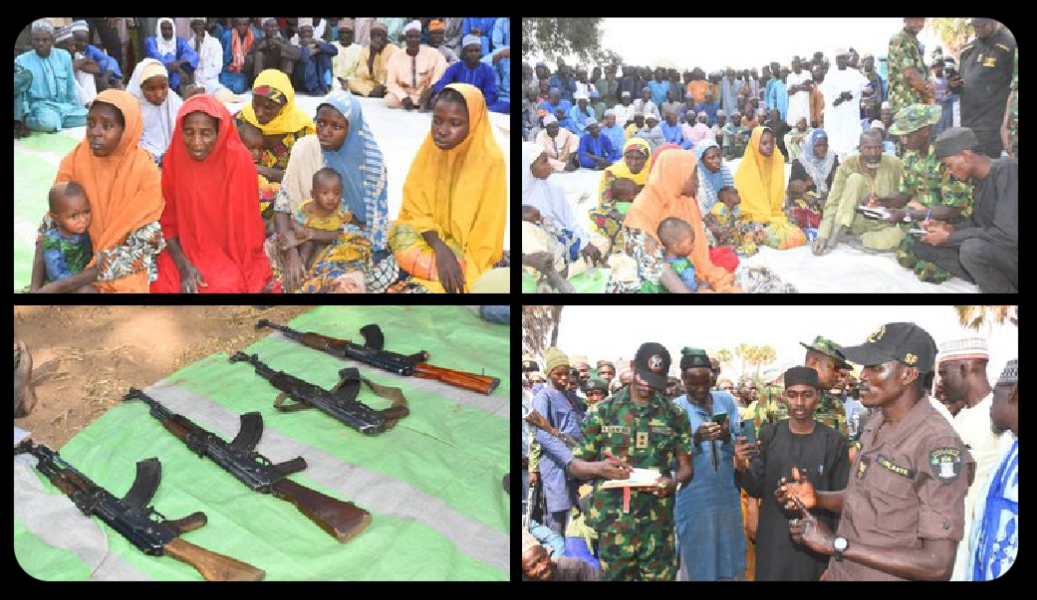
In a significant breakthrough in the fight against banditry, two notorious bandit leaders, Abu Radde and Umar Black, have surrendered their arms and captives in Batsari Local Government Area of Katsina State. This pivotal moment, which occurred on January 19, 2025, is being hailed as a crucial step towards restoring peace and security in the region.
The surrender followed intense and sustained military operations by the combined forces of Operation FASAN YANMA. These operations, which have been relentless in their mission to dismantle criminal networks in Katsina State, compelled the notorious bandit leaders—operating in Batsari and Safana LGAs—to lay down their arms.
The symbolic surrender ceremony, held in Batsari, was witnessed by a broad array of stakeholders, including military representatives and local authorities, to ensure accountability and transparency. During the event, the bandits handed over four AK-47 rifles and released 15 captives, comprising three men, eight women, and four children.
Military officials emphasized that the surrender was not part of a negotiation or peace agreement but rather a decisive step toward disarming the criminals and ensuring the safe release of all kidnapped victims.
Speaking at the event, a military representative highlighted the significance of the surrender. “This development underscores the effectiveness of sustained military pressure. It is a testament to the Nigerian Army’s commitment to restoring peace in Katsina State and beyond,” the officer said.
The surrendered arms, which were confirmed to be in excellent working condition, have been taken into the custody of the 17 Brigade of the Nigerian Army. Meanwhile, the rescued captives have been handed over to the Local Government Authorities for rehabilitation and reintegration into society.
For years, Batsari and Safana LGAs have been plagued by banditry, resulting in loss of lives, displacement of residents, and disruption of livelihoods. The surrender by these high-profile bandit leaders has rekindled hope among residents, who see it as a significant step toward restoring normalcy to their communities.
One of the freed captives, speaking anonymously, expressed profound relief and gratitude to the military for their efforts. “We never thought we’d see freedom again. This is a new beginning for us,” they said.
While the surrender marks progress, security experts caution against complacency. They urge the military to maintain pressure on remaining criminal elements in the region to ensure that banditry is eradicated completely.
The Nigerian Army, in a statement via its official X handle, reiterated its commitment to safeguarding the lives and property of Nigerians. It also called on communities to cooperate with security agencies by providing timely intelligence to prevent the resurgence of criminal activities.
As Katsina State begins to breathe a sigh of relief, the focus now shifts to rehabilitation, reconciliation, and sustainable peacebuilding. The release of captives and surrender of arms may be a promising start, but experts argue that addressing the root causes of banditry, such as poverty and lack of education, remains essential for long-term stability.
This remarkable surrender is not just a victory for the Nigerian Army but also a symbol of hope for the countless communities that have borne the brunt of banditry for far too long. It signifies that with strategic, sustained efforts, peace can indeed be restored to troubled regions.
 PIONEER NEWS