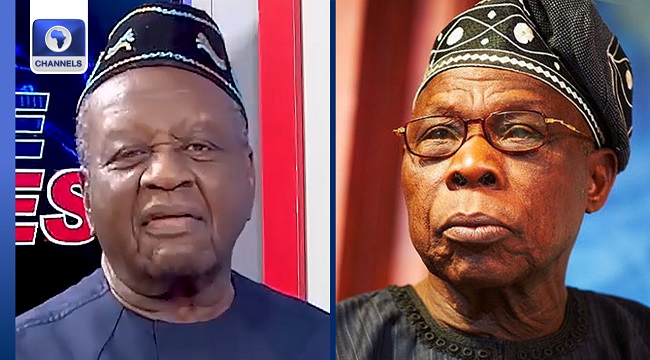
In a startling revelation, Obong Victor Attah, former governor of Akwa Ibom State (1999-2007), has accused former President Olusegun Obasanjo of thwarting his efforts to independently distribute electricity within Akwa Ibom after successfully building a state-of-the-art power plant. Attah made these claims during an exclusive interview on Inside Sources with Laolu Akande, a socio-political program aired on Channels Television.
According to the octogenarian, despite his administration’s commitment to addressing Akwa Ibom’s power needs, the Obasanjo-led Federal Government insisted that electricity generated by the state’s power plant be directed to the national grid, effectively denying the state the autonomy to control its energy resources.
“I decided I want to give Akwa Ibom State power. The president said no, the Federal Government is providing power for the country,” Attah revealed. “I succeeded in building that power station, and the president himself came, commissioned it, and expressed happiness. But when he returned to Abuja, he introduced a law that prohibited states from distributing the power they generate.”
The former governor didn’t stop at recounting his challenges under Obasanjo’s administration. He went on to criticize Nigeria’s current constitution, describing it as an “authoritarian system” imposed by the military. He argued that the nation needs to return to a constitution that reflects the agreements made by the country’s founding fathers at independence.
“What we have now is an authoritarian system called the constitution because it was imposed by the military,” Attah lamented. “We need to go back to an agreeable constitution by our founding fathers at Independence.”
Attah also expressed disappointment with President Bola Tinubu for failing to initiate reforms toward true federalism, which would grant federating units greater autonomy and control over their resources.
Attah’s comments highlight the broader struggle for resource control and the imbalance of power between the federal and state governments in Nigeria. His experience underscores the frustrations of state governors who seek to provide localized solutions but are hindered by federal policies.
The former governor’s revelations have sparked discussions about the role of decentralization in improving governance and development across Nigeria. Observers argue that allowing states to generate and distribute their own electricity could reduce the energy crisis plaguing the nation and drive regional growth.
As Nigerians continue to debate the necessity of constitutional reforms, Attah’s call for a return to the principles of true federalism resonates with growing demands for restructuring the country’s governance framework.
 PIONEER NEWS