
In a landmark decision that underscores the importance of judicial integrity, the Nasarawa State Judicial Service Commission (JSC) has dismissed Chief Magistrate Emmanuel A. Jatau for alleged gross misconduct, forgery, and abuse of power. The decision, announced on Monday, represents a significant victory for accountability in Nigeria’s judiciary.
The Fall of a Magistrate
Jatau, who previously served as Chief Magistrate II (GL 15) in Masaka, Nasarawa State, has been demoted to Senior Magistrate I (GL 14) and stripped of all magisterial duties. The punitive action follows recommendations by the Committee for Appointments, Promotions, and Discipline (CAPD) after it found merit in a petition filed by prominent Nigerian human rights lawyer, Inibehe Effiong.
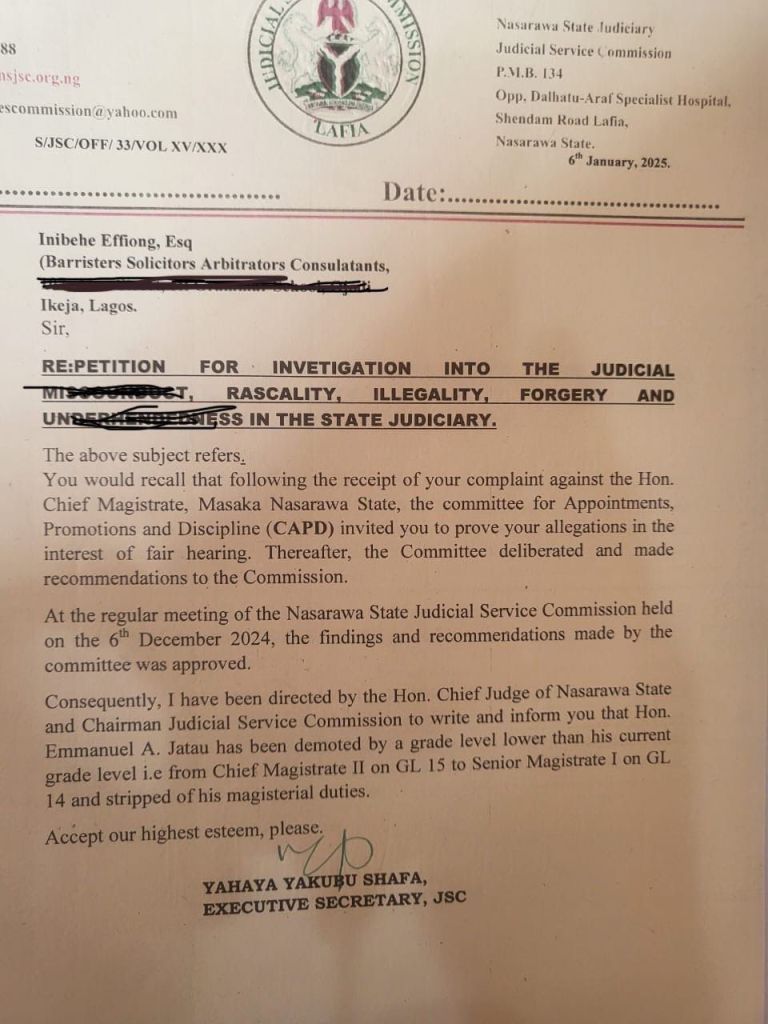
Effiong had lodged the petition in August 2024, accusing Jatau of judicial overreach, falsification of legal documents, and blatant abuse of authority. The petition drew attention to troubling irregularities in the issuance of arrest and detention warrants by the now-disgraced magistrate.
The case at the center of the scandal involved the issuance of fraudulent arrest and commitment warrants against one Okoli Udoka Chioma, a Lagos resident. According to Effiong, the court in Masaka bore official filing stamps from the Federal High Court (FHC) in Lagos—a clear breach of judicial protocols. The stamps were reportedly signed by a staff member of the FHC, Lagos, identified as M. Tofowomo-Adegbite, and were dated January 8, 2024.
Effiong contended that no valid warrants were issued in Lagos, where the defendant resides, or Abuja, where the case originated. Instead, he alleged a conspiracy between police officials and rogue elements within the Nasarawa Judiciary to fabricate documents falsely labeled as legitimate arrest and commitment warrants.
Effiong further argued that the alleged offences did not occur in Nasarawa State, nor did the defendant have any connections to the jurisdiction. This, he stated, rendered the actions of the Nasarawa court both illegal and unconstitutional. “This was not just a case of bad judgment,” Effiong asserted, “but a deliberate manipulation of the judicial system to achieve nefarious ends.”
JSC Speaks Out
In a statement confirming the dismissal, Yahaya Yakubu Shafa, Executive Secretary of the Nasarawa State JSC, emphasized the commission’s commitment to upholding judicial integrity. He noted that Jatau had been given ample opportunity to defend himself during the CAPD hearings but was ultimately found culpable.
The statement read: “Following the receipt of your complaint against the Hon. Chief Magistrate, Masaka, Nasarawa State, the Committee for Appointments, Promotions, and Discipline (CAPD) invited you to prove your allegations in the interest of fair hearing. After a thorough review, the commission approved the disciplinary measures taken against the magistrate.”
This dismissal is being hailed as a watershed moment in the fight against judicial corruption in Nigeria. Effiong praised the decision, describing it as “a step in the right direction towards restoring faith in the judiciary.” Legal experts have also lauded the action, calling it a clear warning to other judicial officers who might consider straying from the path of integrity.
As Nigeria grapples with the challenges of judicial reforms, the dismissal of Chief Magistrate Jatau sends an unambiguous message: no one is above the law. The case serves as a sobering reminder that justice must be impartial, transparent, and guided by the rule of law.
This development underscores the need for continuous vigilance and activism to ensure that Nigeria’s judiciary remains a beacon of justice rather than a tool for exploitation.
 PIONEER NEWS