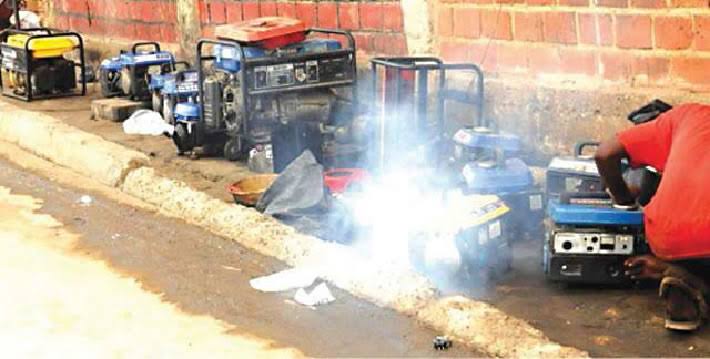
In a jaw-dropping revelation, Sahara Reporters has taken to its official X handle to disclose that Nigeria’s State House, Ministry of Defence, Economic and Financial Crimes Commission (EFCC), and 41 other ministries, departments, and agencies (MDAs) plan to spend a staggering N14.2 billion on fueling generators in 2025. This revelation follows an in-depth review of the proposed 2025 budget, spotlighting Nigeria’s perennial dependence on diesel-powered generators to sustain critical operations amidst the nation’s electricity supply challenges.
Key Highlights from the Budget Review
The State House Headquarters, which houses the Presidency, leads the expenditure pack with a whopping N1.989 billion earmarked for fueling plants and generators.
The Nigerian Army follows closely, budgeting an eye-watering N3.897 billion, while the Ministry of Defence Headquarters intends to spend N250 million.
Anti-corruption agencies like the EFCC and the Nigerian Financial Intelligence Unit (NFIU) have also joined the big spenders’ league, allocating N1.195 billion and N33.6 million, respectively.
More Agencies Under Scrutiny
Further scrutiny reveals that various federal agencies and educational institutions are equally entrenched in the fueling frenzy:
The Nigeria Defence Academy (NDA) has earmarked N399.5 million, while the Nigerian Defence College plans to spend N337.4 million.
The Federal Road Safety Commission (FRSC), tasked with ensuring road safety nationwide, has shockingly allocated N2.5 billion—the second-highest amount on the list—for generator fuel.
The Federal Ministry of Finance Headquarters and the National Cybercrime Coordination Centre have budgets of N250 million and N91.9 million, respectively.
A Nation Struggling with Power Deficiency
This extensive reliance on generators exposes Nigeria’s enduring struggle with electricity generation and distribution. While the country battles to reform its power sector, MDAs continue to allocate massive sums toward fueling generators, diverting funds that could otherwise be used for infrastructure development and social welfare programs.
Smaller Budgets, Same Story
Even smaller institutions are not left out:
The National Institute for Policy and Strategic Studies (NIPSS) plans to spend N14 million, while the Bureau of Public Enterprises has budgeted N36.2 million.
The National Centre for Control of Small Arms and the National Intelligence Agency (NIA) are allocating N103.6 million and N167 million, respectively.
Critics argue that these expenditures reflect poor planning and a lack of innovation in addressing Nigeria’s energy crisis. Questions are being raised about why solar or other renewable energy solutions are not being prioritized as more sustainable and cost-effective alternatives.
The public is demanding transparency and a reassessment of these budgetary allocations. Activists are calling on the government to provide a detailed justification for such monumental spending on fuel, especially at a time when millions of Nigerians face economic hardship.
This revelation is not just a wake-up call but a glaring reminder of the pressing need for Nigeria to rethink its approach to energy management. Experts have suggested that transitioning MDAs to solar and hybrid systems could significantly cut costs and reduce reliance on fossil fuels, aligning with global trends in sustainability and environmental protection.
As 2025 approaches, all eyes are on the federal government to ensure that these funds are spent judiciously, with a focus on delivering long-term solutions to Nigeria’s energy woes.
 PIONEER NEWS