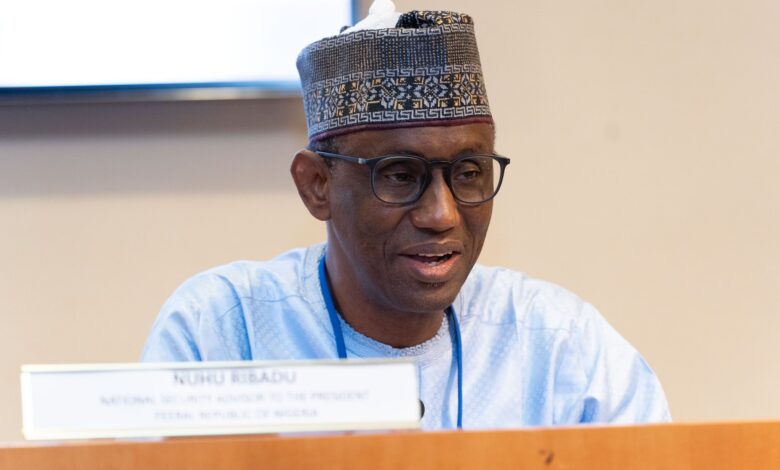
In a bold clarification, Nigeria’s National Security Adviser (NSA), Nuhu Ribadu, has categorically denied rumors of plans for a French military base in the country. Addressing speculations, Ribadu reaffirmed Nigeria’s long-standing policy against hosting foreign military installations, citing the government’s refusal even when the United States sought to establish a base on Nigerian soil.
Ribadu, speaking during an official briefing, emphasized Nigeria’s commitment to safeguarding its sovereignty and territorial integrity, asserting that the country would not compromise its independence by accommodating foreign military outposts. He noted that while Nigeria has declined such offers, neighboring Niger Republic had previously accepted similar proposals, illustrating a stark contrast in regional security approaches.
The NSA’s remarks shed light on Nigeria’s consistent stance against foreign military bases, a policy deeply rooted in the nation’s post-independence drive for self-determination and non-alignment. Ribadu explained that Nigeria’s rejection of the United States’ request for a military base underscored the government’s resolve to prioritize indigenous solutions to security challenges.
“We are a sovereign nation with a proud history of standing on our own. Hosting foreign military bases is not and will never be part of our security strategy,” Ribadu declared.
Ribadu also pointed out the implications of Niger Republic’s decision to host foreign forces, particularly in the wake of recent political and security upheavals in the Sahel region. The presence of foreign troops in Niger has sparked widespread debates about the impact of external military involvement on African sovereignty and stability.
With growing concerns over the influence of global powers in West Africa, Ribadu’s comments highlight Nigeria’s determination to chart its own course in addressing security threats. The country has instead focused on strengthening regional cooperation through platforms such as the Economic Community of West African States (ECOWAS) and the African Union (AU).
The revelation, shared via Sahara Reporters’ official X handle, quickly went viral, sparking diverse reactions across social media. Many Nigerians praised the government’s steadfastness, describing it as a testament to the country’s independence and self-reliance.
Others, however, questioned whether Nigeria’s refusal of foreign bases could hinder its ability to effectively combat transnational threats such as terrorism, banditry, and piracy. Critics argued that strategic partnerships, including hosting military bases, could bolster Nigeria’s defense capabilities in an increasingly volatile region.
By reiterating Nigeria’s position, Ribadu sent a strong message to global powers about the nation’s unwavering resolve to maintain its sovereignty. The NSA called on international allies to respect Nigeria’s stance and collaborate in ways that strengthen its domestic security frameworks rather than impose foreign dominance.
“Nigeria remains open to partnerships, but these must respect our autonomy and prioritize mutual benefits,” Ribadu stated.
Ribadu’s statements come at a time of heightened global interest in Africa’s geopolitical landscape. As external powers jostle for influence in the region, Nigeria’s firm stance serves as a reminder of its leadership role and commitment to safeguarding its independence.
In a region fraught with challenges, Ribadu’s declaration underscores Nigeria’s resolve to remain a beacon of sovereignty, charting a course defined by self-reliance and regional collaboration.
 PIONEER NEWS