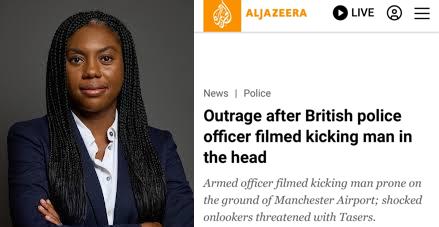
Renowned human rights activist and former Nigerian Senator, Shehu Sani, has once again captured public attention with his piercing commentary on international politics. In a recent post on his official X handle (formerly Twitter), Sani responded to remarks made by UK Conservative politician Kemi Badenoch, who had criticized the Nigerian police, branding them as an institution that exploits the very citizens they are meant to protect.
In his characteristic style, Sani pointedly remarked, “Madam UK politician didn’t see that of the British Police.” This statement, laden with subtle irony, appeared to challenge Badenoch’s perceived one-sided criticism, suggesting that systemic issues within law enforcement are not exclusive to Nigeria but also exist in the United Kingdom.
Kemi Badenoch, a Nigerian-born British Conservative leader and current Secretary of State for Business and Trade in the UK, recently made headlines for her critical comments about Nigeria’s police force. Her remarks were seen as a sharp indictment, accusing them of betraying public trust and engaging in corrupt practices.
While many Nigerians resonated with Badenoch’s critique, Sani’s retort highlighted a broader perspective, urging leaders and observers to consider issues of police misconduct globally. The British police force itself has faced several controversies in recent years, ranging from allegations of institutional racism to misconduct and excessive use of force.
Sani’s response underscores the importance of balanced critique and self-reflection, especially when addressing sensitive issues like law enforcement and governance. As someone who has been a vocal advocate for accountability and justice, Sani’s message appears to urge leaders to adopt a holistic approach to such criticisms.
The clash of perspectives between Sani and Badenoch has sparked a lively debate on social media, with many Nigerians divided over the appropriateness of Badenoch’s comments and the validity of Sani’s counterpoint.
This exchange serves as a reminder of the interconnectedness of global issues, where challenges like police reform transcend borders. It also calls for constructive dialogue, rather than divisive rhetoric, as the world grapples with shared problems in governance and justice.
Shehu Sani’s candid remarks once again demonstrate his role as a fearless voice in advocating for fairness, accountability, and the need to look inward before casting stones.
 PIONEER NEWS