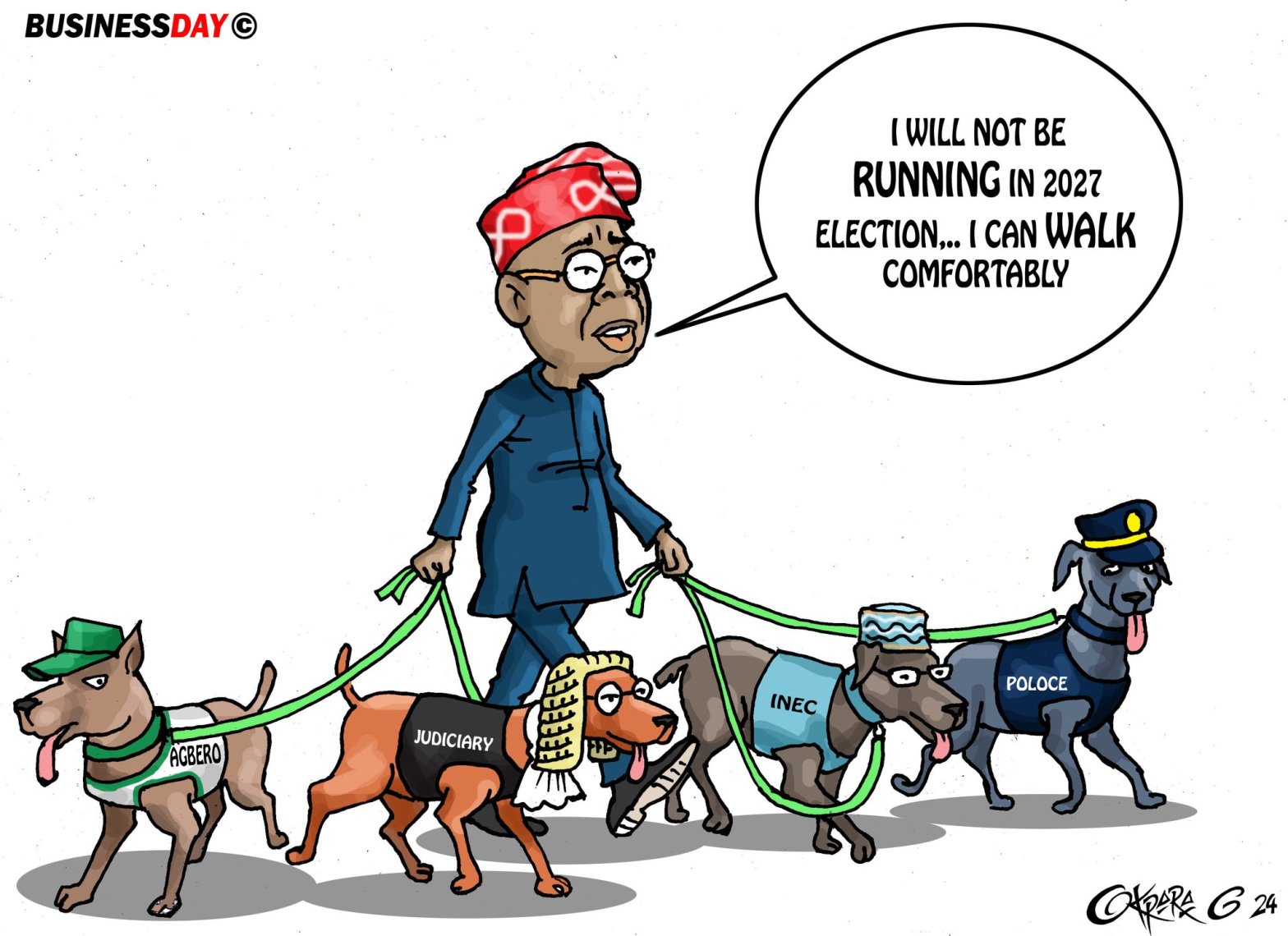
In a striking satirical cartoon that encapsulates the state of Nigeria’s political landscape, President Bola Ahmed Tinubu is depicted holding the leashes of four symbolic dogs, each representing powerful institutions crucial to the success of any political endeavor in the country: the Agbero (thugs), the Judiciary, INEC (Independent National Electoral Commission), and the Police. The cartoon humorously portrays Tinubu as confidently stating, “I will not be running in 2027 election… I can walk comfortably.”
This clever artwork, while humorous, addresses deeper concerns about the influence wielded by political figures over key institutions and individuals. It suggests a landscape where the power to manipulate various arms of governance and control civic groups could tilt the scale of democracy.
The Dogs of Political Influence
Each dog in the cartoon represents an essential aspect of the Nigerian electoral system, with the clear insinuation that these institutions may have been tamed or co-opted to serve the interests of the political elite.
Agbero (thugs): Agberos, often synonymous with touts or street enforcers, have long been rumored to serve as political muscle during elections. Their presence in this cartoon under Tinubu’s control suggests the unspoken but powerful role that intimidation and coercion play in shaping electoral outcomes. This satirical portrayal points to an uncomfortable truth about the intersection of street power and political authority.
Judiciary: The Judiciary is depicted as another subdued institution, reflecting concerns that it may not always act as the impartial arbiter of justice that it is intended to be. Elections in Nigeria have often involved court battles, and this illustration subtly implies that political pressure could influence judicial outcomes.
INEC: The Independent National Electoral Commission (INEC), responsible for overseeing elections, is another critical institution portrayed as under Tinubu’s guidance. INEC’s credibility is crucial for free and fair elections, and this satirical imagery challenges the integrity of the electoral process if it is perceived as being compromised.
Police: The Police, often tasked with maintaining law and order during elections, are shown in the cartoon as another tool at Tinubu’s disposal. Their role in securing the electoral process can be a double-edged sword, and this artwork implies that their neutrality may be compromised in favor of political agendas.
Tinubu’s Stride of Confidence
The central figure of Tinubu, with his traditional attire and characteristic cap, stands out as a man in full control of his political destiny. His quip, “I will not be running in 2027 election… I can walk comfortably,” adds a layer of irony to the cartoon. While he humorously dismisses the need to “run” for office, the implication is that he has all the mechanisms in place to smoothly secure his position without the need for a strenuous campaign.
This satirical remark also alludes to Tinubu’s possible future ambitions. Having successfully secured power in 2023, the message in the cartoon is that his grip on the institutions of power is firm enough to allow him to maintain dominance in future elections with little effort. The cartoonist subtly critiques the idea of democracy being reduced to mere formalities when power is concentrated in the hands of one individual or political group.
The Broader Implications
Beyond its humor, the cartoon reflects deep-seated frustrations and concerns about the state of governance and democratic integrity in Nigeria. It challenges the notion of electoral fairness and independence in a system where political elites may have undue influence over institutions meant to serve the public interest.
The portrayal of Tinubu walking confidently with these institutions in tow raises questions about the future of Nigerian democracy. Will the 2027 elections be a free and fair contest, or will it be a mere formality, with the outcome already secured by those in power? The cartoon prompts viewers to reflect on the balance of power in Nigeria and whether true electoral competition can exist in such an environment.
Conclusion
This cartoon serves as a poignant commentary on Nigerian politics, cleverly using satire to expose the uncomfortable truths surrounding political influence and institutional control. While humorous on the surface, it is a stark reminder of the need for vigilance in safeguarding democracy and ensuring that key institutions remain independent and accountable to the people, not just the political elite.
The imagery of Tinubu calmly walking into the 2027 elections with powerful institutions at his side is a thought-provoking symbol of the state of governance, leaving viewers to ponder the real state of Nigerian democracy and the future it holds.
 PIONEER NEWS