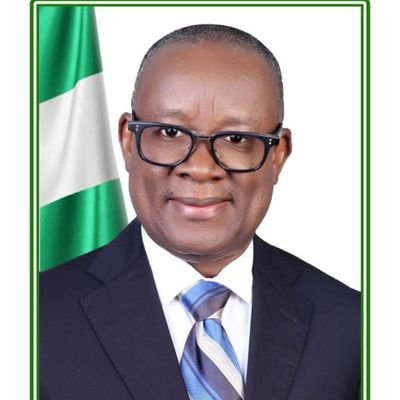
Senator John Owan Enoh, Nigeria’s Minister of Sports Development, has publicly expressed his deep disappointment over Nigeria’s subpar performance at the Paris 2024 Olympic Games. Sharing his sentiments on his official X (formerly Twitter) handle, the Minister issued an apology to Nigerians, acknowledging that the nation’s results fell far short of expectations.

“The Paris 2024 Olympic Games have concluded, and I must admit that our performance did not meet the high hopes and aspirations of Nigerians,” Enoh stated. “I apologize to our compatriots and assure them that we are reflecting on what went wrong as we now turn our focus to the upcoming Paralympic Games.”
Enoh, who took office in August 2023, faced the daunting task of preparing Nigeria’s teams for four major international competitions in a limited timeframe: the Africa Cup of Nations (AFCON), the African Games, the Olympics, and the Paralympics. Despite the Olympic Games requiring extensive preparation typically spanning four years, Enoh inherited a situation where preparations had barely begun.
“Upon assuming office, I immediately recognized the gravity of the challenge before us. Our goal was to replicate or even surpass the glory of Atlanta 1996, but we had to start from scratch. We launched an ambitious plan to improve our athletes’ performance despite the odds,” he explained.
In a bid to fast-track preparations, Enoh requested comprehensive plans from all National Sports Federations and initiated a nationwide inspection of sports facilities. He also formed the Ministerial Podium Performance Advisory Committee, comprising seasoned sports professionals, to drive the country’s Olympic preparations. Despite these efforts, Nigeria faced significant hurdles.
“We had athletes competing in both the African Games and Olympic qualifiers in quick succession, which strained their ability to peak at the right times,” Enoh noted. “While many countries had athletes who qualified nearly a year in advance and had structured training accordingly, our athletes were still fighting for qualification until June 2024.”
Enoh convened several strategy meetings with the heads of National Sports Federations, their technical directors, and other key stakeholders to streamline training methods and ensure that Nigeria’s athletes were as prepared as possible under the circumstances. However, the emphasis on qualification over preparation emerged as a recurring issue that hampered Nigeria’s overall performance.
“The selection of athletes and coaches was left entirely to the Federations, and any attempts to question these choices were met with resistance,” Enoh revealed.
To maximize the limited time, the Ministry approved both onshore and offshore training camps for the athletes. Ten out of the eleven sports federations opted to train in Saarbrucken, Germany, and Sevilla, Spain. These locations were chosen based on the recommendations of seasoned professionals, including a former Olympic gold medalist who is well-versed in Olympic-standard facilities.
“In Germany, our teams received scientific and mental strength training, which we hoped would give them an edge. Unfortunately, despite these efforts, we did not achieve the desired outcomes,” Enoh lamented.
As Nigeria turns its attention to the upcoming Paralympic Games, Enoh emphasized the need for a comprehensive review of the nation’s sports strategies to avoid a repeat of the Paris 2024 disappointment. “We must learn from our mistakes and build a stronger foundation for the future. The time for change is now,” he concluded.
 PIONEER NEWS