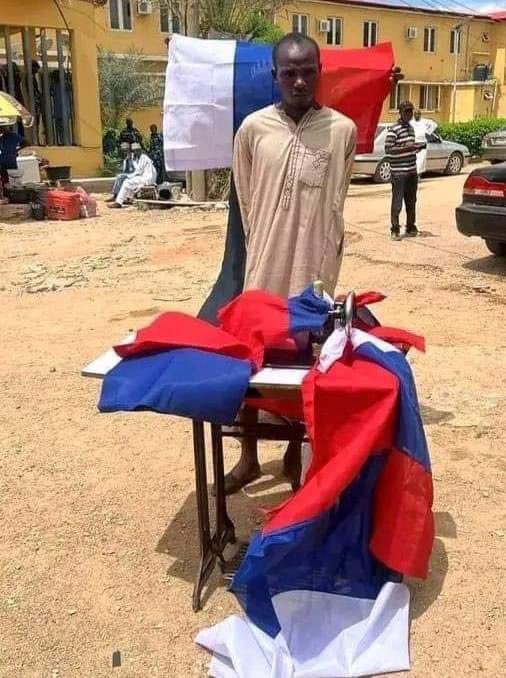
In a riveting revelation, prominent security analyst and counter-insurgency expert Zagazola Makama took to his X social media channel to address the ongoing controversy surrounding the so-called “Nigerian-Russian flag.” According to Makama, the Department of State Services (DSS) has made significant strides in its investigation.
“The DSS can confirm that Adaramoye Michael, also known as Michael Lenin, is not in its custody,” Makama stated. “However, the Service has apprehended several tailors in Kano State responsible for producing the alleged Russian flags being distributed in the area. Some of their sponsors have also been detained. Investigations are ongoing.”
Adaramoye Michael, dubbed “Michael Lenin,” has become a focal point in the controversy. Despite initial rumors, the DSS clarified that Lenin is not in their custody, steering the narrative towards the actual culprits: a network of tailors in Kano State.
The DSS’s apprehension of the tailors involved in crafting the flags marks a pivotal development. These flags, initially perceived as Russian, have stirred significant political and social debate. The DSS’s move to detain the tailors’ sponsors further underscores the gravity of the situation and the intricate web of actors behind the scenes.
The controversy revolves around the red, blue, and white flag, which closely resembles the Russian national flag but is also the official flag of the Nigerian Armed Forces. This dual symbolism has fueled confusion and speculation, with media outlets and analysts drawing parallels to pro-Russian sentiments and anti-Western rhetoric observed in other African nations
The media’s portrayal of the flag as a symbol of Russian allegiance has amplified the controversy. Despite the absence of explicit references to Russia by the protesters, the narrative persists, suggesting a broader geopolitical agenda at play. This scenario highlights the media’s influential role in shaping public perception and the urgent need for accurate, context-driven reporting.
The Nigerian government’s reaction, characterized by swift arrests and ongoing investigations, reflects its determination to quell any perceived threats to national security. The public’s response, including increased flag displays by protesters, underscores a defiant stance against the government’s narrative.
As investigations continue, the Nigerian-Russian flag controversy serves as a complex case study of symbolism, media influence, and political maneuvering. The tale of Michael Lenin and the tailors of Kano State reveals a layered narrative that demands careful scrutiny and a commitment to uncovering the truth.
 PIONEER NEWS