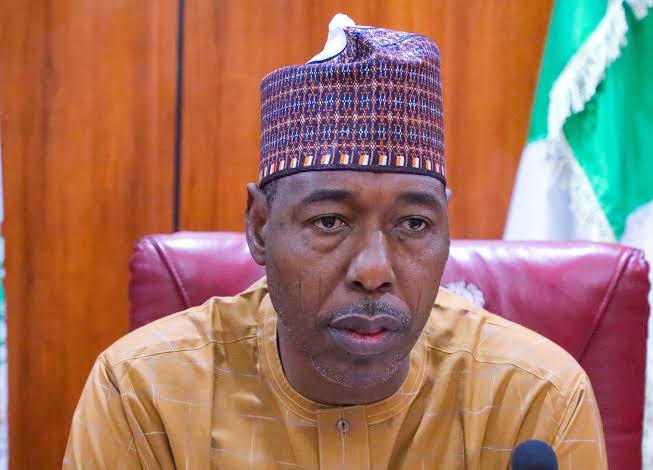
In a significant humanitarian effort, Borno State Governor Babagana Umara Zulum on Sunday supervised the distribution of food items and agricultural inputs to over 35,000 male heads of households in Monguno Local Government Area. This initiative aims to alleviate the hardship faced by residents due to the high cost of food items and to support local agriculture.

Each beneficiary received a 25kg bag of rice and cowpeas, essential for cultivating their farmlands. Governor Zulum highlighted that the rice was part of a consignment of 20 trucks donated by the federal government to the state.
“We are in Monguno town mainly for two functions: first, to distribute food items provided by the federal government. Twenty trucks of rice were given to us, and this morning, we distributed all of them to this community,” Zulum stated. “In addition to this, we have also distributed seeds, as most residents lack the capacity to purchase farm inputs. We provided cowpeas to all able heads of households.”

Governor Zulum also announced the federal government’s provision of 90 trucks of fertilizer to the state, intended for free distribution to farmers. Expressing gratitude, he said, “On behalf of the people of Borno State, I appreciate the federal government for this laudable gesture.”
In a parallel effort, Governor Zulum distributed over N450 million to 45,000 widows and vulnerable women in Monguno. Each recipient received N10,000 in cash support and a wrapper. “We have distributed cash support and wrappers to over 45,000 widows and vulnerable women in Monguno town,” the Governor noted.

Governor Zulum emphasized that these distributions are not meant to create dependency but to support families that have lost their livelihoods due to the Boko Haram crisis. “The distribution of palliatives by our administration aims to support vulnerable families and help them rebuild their lives,” he affirmed.
This comprehensive aid initiative underscores the Borno State government’s commitment to addressing the immediate needs of its citizens while fostering resilience and self-sufficiency in the face of ongoing challenges.

 PIONEER NEWS